Metal Roof Installation
New roofs specified for salt exposure from the start.
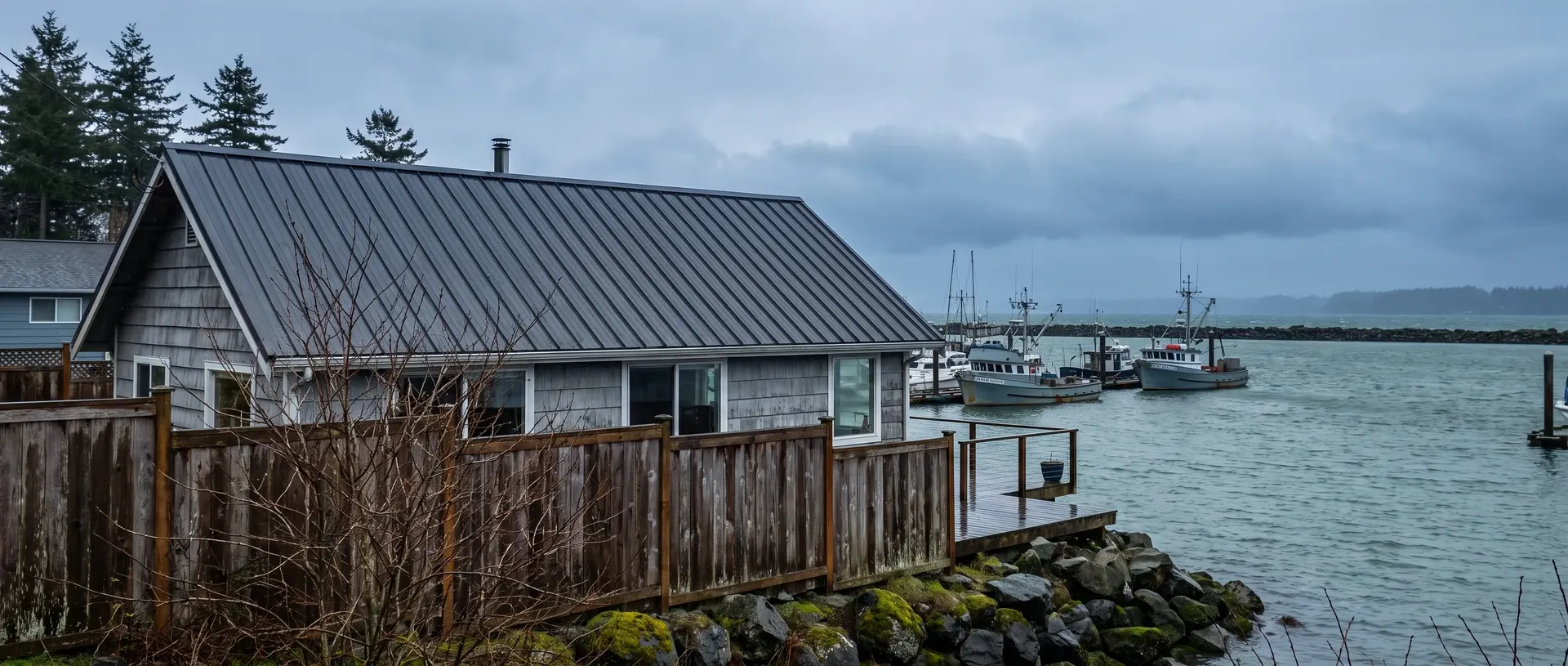
Installation, replacement and repair on Blaine roofs, where salt air gets at the fixings years before anything happens to the panels.
Blaine roofs age from their fixings inward.
Salt air comes off Drayton Harbor and the Strait constantly, not just in storms, and it settles on everything. On a roof it goes to work at the vulnerable points first: exposed fastener heads, cut panel edges, flashing laps, and anywhere two different metals are touching. A roof that would give you decades of untroubled service three miles inland can show corrosion here in a fraction of that time if the wrong fastener went in.
Wind compounds it. There is very little shelter between the water and most of these houses, so driven rain carries salt further under edges and laps than gravity alone would.
The housing mix is its own thing too. Older waterfront cottages with small awkward roofs and a history of additions. Retirement builds from the last few decades. Newer view homes out toward Semiahmoo where the roof is a large part of what the house looks like. Three different jobs on three neighbouring streets.
What changes here is specification more than technique. Fastener choice, flashing material, and keeping incompatible metals apart matter more in Blaine than anywhere else in the county.
Services here
New roofs specified for salt exposure from the start.
Usually a roof whose fixings have gone long before its panels.
Corroded fasteners, flashing laps and edge details.
No exposed fasteners is worth more here than anywhere else in the county.
Where the panels are sound and the surface has taken a beating.
Exposed coastal sites in a winter southwesterly.
Local detail, Blaine
The single most important decision on a coastal roof is what holds it down and what the flashings are made of. Getting that right costs a little more once. Getting it wrong costs a roof.
Dissimilar metals in contact, in salt air, corrode faster than either would alone. That governs fasteners, flashings, gutters, vents and anything somebody has added over the years.
A lot of roofs here sit empty for months. A leak that would be noticed in a day elsewhere runs unseen through a whole winter, so we look harder at the deck and the attic on these than we would inland.
Questions
It does not ruin a well specified one, but it is unforgiving of a badly specified one. What corrodes first is fasteners, cut edges and flashings rather than the coated panel face. The practical answer is choosing fixings and flashing materials rated for coastal exposure and keeping incompatible metals from touching, which is a decision at estimate time rather than a maintenance job later.
Generally yes. Composition here has to deal with the same salt plus wind lifting individual shingles, and it has a shorter life to begin with. The caution is that a cheap metal roof with the wrong fasteners on the water can fail faster than a good composition roof, so this is the worst place in the county to shop purely on price.
Same exposure, same specification approach. We work both, and Birch Bay has its own card on our service areas page. The only real difference is that some of the newer view homes have more complex roof geometry, which means more flashing work and a higher proportion of the cost in details.
More often than an inland one, and mostly at the details. Once a year, look at fastener heads, flashing laps, and anywhere something has been added to the roof. If the house sits empty part of the year, have somebody look after the first big storm rather than in spring.
Around here
Birch Bay, Custer, Ferndale, Lynden, Bellingham, Point Roberts and Sumas.
Free on site assessment
Monday to Friday, 7am to 4pm. Emergency calls outside those hours for active leaks and storm damage.
We will call you back, usually the same working day, and we will ask a couple of questions to work out whether this is urgent before we book a time to get on the roof.