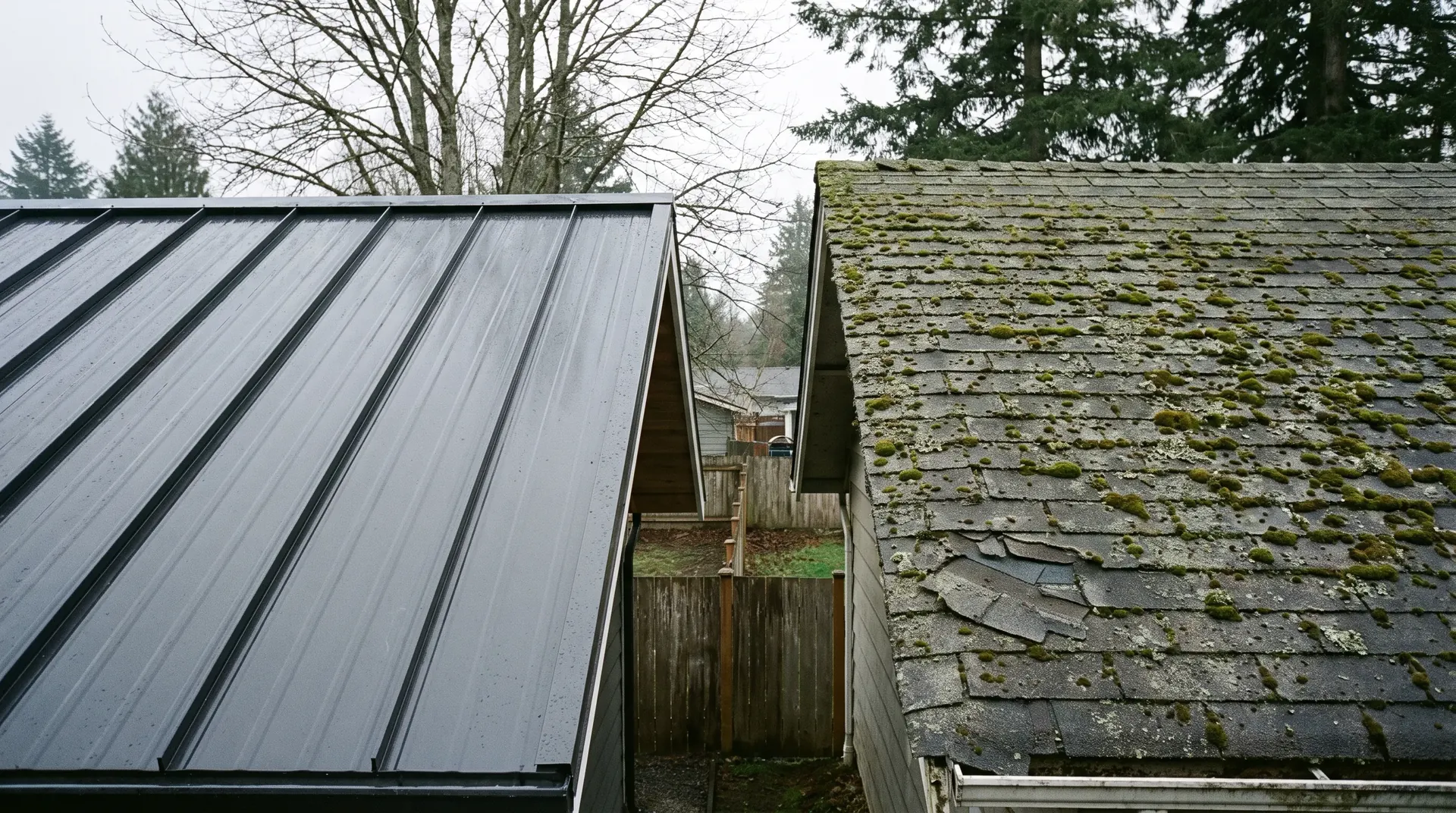
Shingles cost less to buy and less to install. Metal costs more up front and lasts two to three times as long. That is the whole comparison. What matters is how it plays out on a house in this county specifically.
If you are staying in the house, metal usually wins here, because our climate attacks a shingle roof in exactly the way shingles are worst at handling. If you are selling within a couple of years, shingles are the rational choice and anyone telling you otherwise is selling a roof rather than advice.
What our weather does to a shingle roof
Composition shingles fail here through moisture and growth rather than through sun. A shingle is a mat with granules bonded to it, and every one of those layers is a place for water to sit. Under fir canopy on a north slope, that roof does not dry properly for months at a time.
Moss establishes at the shingle edges, lifts them slightly, and holds water underneath. Fir needles pack into the valleys and turn into a wet mat. Granules wash off into the gutters, and the exposed mat ages faster. None of that is dramatic, and that is why people miss it until the roof is done.
What our weather does to a metal roof
Metal sheds. There are no granules to lose, no mat to soak, and nothing for moss to root into, so the growth that kills a shingle roof sits on top of a metal one and is mostly a cleaning problem.
Metal roofs here fail in one of two ways instead. On exposed fastener systems, the screws and their rubber washers age out and start letting water through, which is a maintenance cycle rather than an event. On any system, a flashing detail that was wrong from the start leaks at the chimney, the wall or the valley. Both of those are repairable without touching the rest of the roof.
Cost, honestly
The only number that means anything is the one measured off your roof.
Metal costs more than composition, and standing seam costs more than exposed fastener metal. The gap is real and it is not small. What the up front number leaves out is how many times you buy the cheaper roof.
The other thing the up front number leaves out is the tear off. When a shingle roof reaches the end, you pay to remove and dispose of it before you pay for the new one. A metal roof that lasts through what would have been two shingle roofs saves you one of those tear offs as well.
Noise, the objection everybody raises
This comes from barns, where panels are screwed straight to purlins with open air underneath. On a house, over a solid deck with underlayment and an insulated attic below, rain on metal is not meaningfully louder than rain on shingles.
If your attic is uninsulated or the roof is over a vaulted ceiling with little between you and the deck, the objection is more reasonable, and it should be part of the conversation rather than dismissed.
Resale, and the case for shingles
A metal roof does not pay for itself at resale, and any contractor promising it will is guessing at your buyer. What a new roof of either material does is remove an objection and take a negotiating lever away from the buyer.
Which means: if you are selling soon, a good composition roof does that job for less money. Metal earns its cost through the years you own the house, not on the closing statement. That is the honest case for shingles and it applies to a real number of houses.
How to compare two estimates
Most of the difference between two quotes for the same roof is not the panel. It is:
- Whether the old roof comes off or the new one goes over it
- What underlayment is specified, and whether membrane goes at eaves, valleys and penetrations
- Whether flashings are formed on site or bought as stock pieces and forced to fit
- Panel gauge and finish quality
- Whether there is a deck repair allowance in writing
- Who carries the disposal cost
Two estimates that differ by thousands usually differ on that list. Ask both contractors to put those lines in writing and the comparison becomes straightforward.
When to get somebody on the roof
- Granules collecting in the gutters, or bare patches visible on the shingles
- Moss established across a slope rather than in patches
- A roof over twenty years old that has never been properly looked at
- Any active leak, in either material
- A metal roof where you can see fastener heads standing proud of the panel
None of those mean a replacement is due. They mean somebody should get up there and tell you which of the four possible answers you are looking at: nothing yet, a repair, a coating, or a new roof.