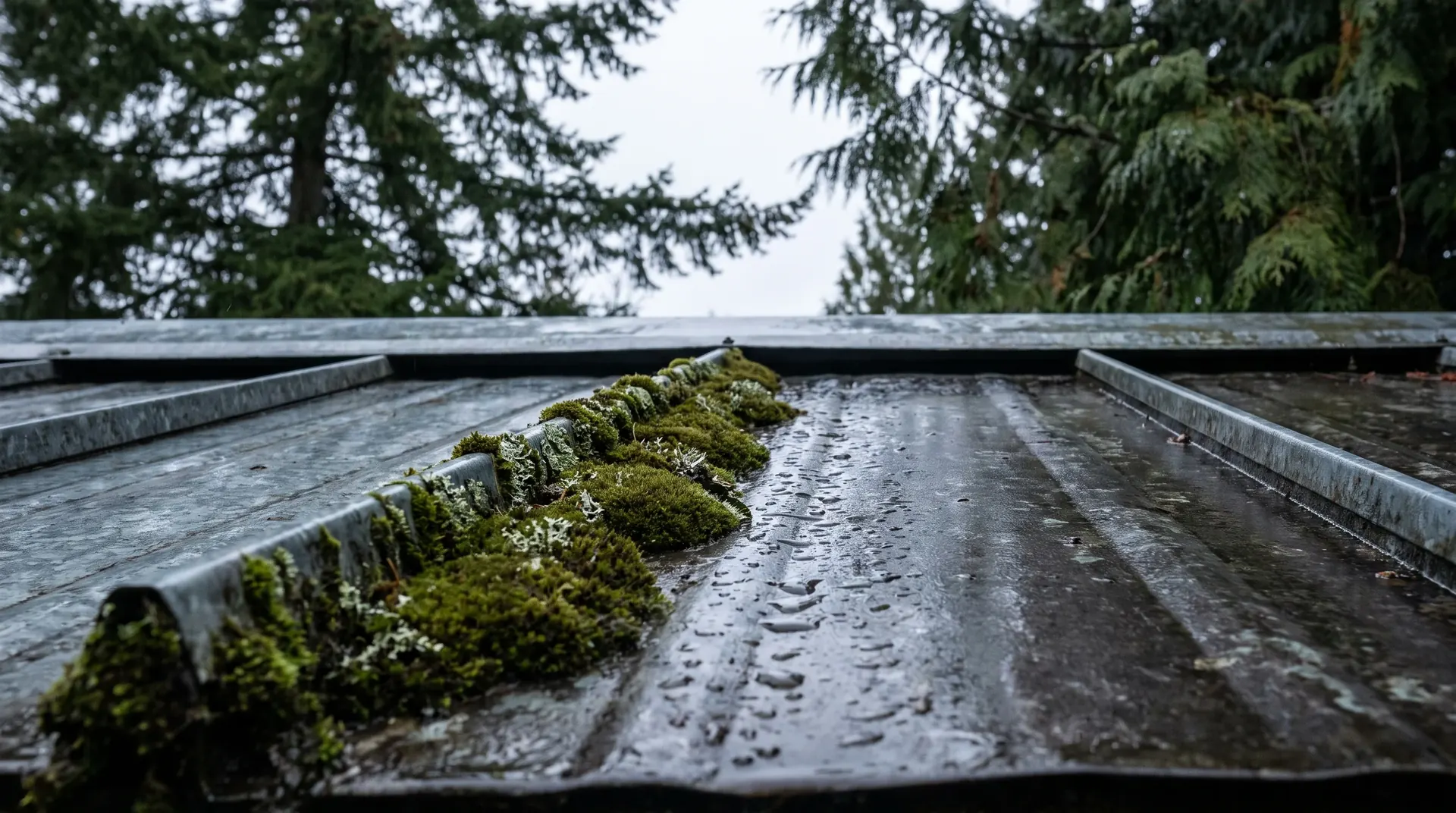
A metal roof in this climate is measured in decades rather than years, and the panels are almost never what ends it. What ends it is a fastener, a flashing, a valley full of fir needles, or a detail that was wrong the day it went on.
That is good news, because every one of those is either preventable or repairable. Here is what actually ages a metal roof between Bellingham and the border, in the order it matters.
Fasteners, on an exposed fastener roof
This is the number one reason metal roofs get replaced here. An exposed fastener roof is held on by screws driven through the face of the panel, each sealed by a rubber washer. There can be several thousand of them.
Washers harden and crack. Screws back out slightly as panels expand and contract. The hole opens up. None of it is visible from the ground, and it happens while the panels themselves are still in good condition.
That fastener cycle is the single biggest argument for standing seam, where nothing holding the roof down is exposed to weather at all.
Flashings and details
Chimneys, sidewalls, skylights, vents, valleys, and anywhere a roof plane meets something else. On any roof of any material these are where water gets in, and on metal they are the difference between a roof that is quietly perfect for thirty years and one that needs somebody up there every winter.
Flashings formed on site for the actual detail last. Stock pieces bent to fit and helped along with sealant do not. This is where the money goes in a good installation and where it is saved in a cheap one.
Moss, lichen and needle load
Moss does not eat metal. What it does is hold water against the panel and against the laps, indefinitely, on a slope that already never dries.
Fir needles are worse, and they are everywhere in the shaded Bellingham neighbourhoods. They pack into valleys, compost, and form a wet mat that backs water up under the panel edge. That is a leak with no failed component anywhere near it.
Both are maintenance. Clearing valleys and keeping growth off the roof does more for its life than anything else you can do without spending money.
Condensation, from underneath
Less obvious and more common than people expect. A poorly ventilated attic under a metal roof will condense moisture on the underside of the deck, which rots sheathing without a single drop coming through from outside.
If your roof is being replaced, ventilation is part of the job. If somebody quotes you a metal roof and never mentions your attic, that is worth noticing.
Salt air, near the water
At Blaine, Birch Bay, Semiahmoo and along the Chuckanut side, salt is in the air permanently rather than occasionally. It attacks fasteners, cut edges and flashing laps first, and it accelerates any place two dissimilar metals are touching.
This is a specification question answered at estimate time. Coastal rated fixings and compatible flashing materials cost a little more once. The wrong ones cost a roof early.
What actually extends the life
- Keep valleys and gutters clear, particularly under fir
- Deal with moss before it establishes in the laps
- Get the fasteners looked at on an exposed fastener roof rather than waiting for a leak
- Keep foot traffic off the roof, and keep anyone who does go up on the fasteners and not the flats
- Fix a flashing when you notice it, not after a winter of thinking about it
None of that is expensive. All of it is the difference between a roof that is finished at twenty years and one that is barely middle aged.
When to get somebody up there
- Fastener heads standing proud of the panel, or visible rust rings around them
- Moss established across a slope, or valleys you cannot see the bottom of
- Staining on the sheathing or wet insulation in the attic
- Any repair somebody made with roofing tar or hardware store silicone
- A coastal roof that has not been looked at in years
An assessment is free, and the most common outcome on a metal roof is that it needs cleaning and a couple of details attended to rather than replacing.